Written 2026-01-11
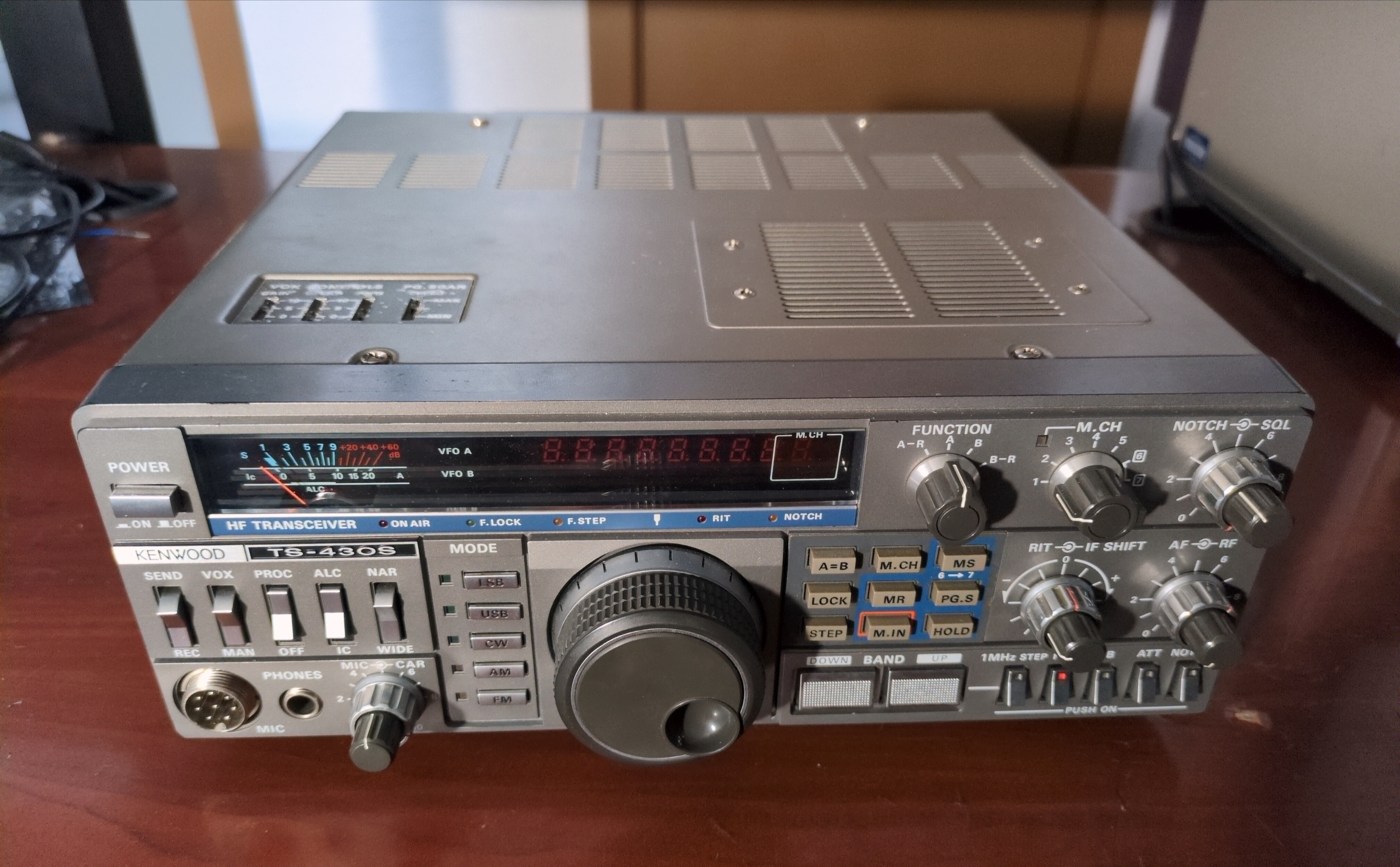
In July of 2025, I upgraded my amateur radio operator's license from technician class to general class. This change gave me privileges to transmit on lower-frequency HF radio bands where signals can travel past the horizon. To start, I bought a simple dipole antenna and a "cheap" 40-year-old Kenwood TS-430S transceiver. I had listened to the incoming signals as soon as I got the radio, but it wasn't until winter break that I finally got around to configuring my setup for transmission.
After hanging my 33-foot antenna in a tree and properly tuning it, I was ready to go. I powered on my radio and immediately heard a station loud and clear from Anchorage Alaska, over 1700 miles from my Grandma's home in Southern Oregon. This was the furthest station I'd ever heard! I took a quick dinner break, then came back to the radio, excited to finally get on the air with HF... and it didn't turn on. The frequency display was completely blank, and I was unable to hear anything but noise. Somehow, in the span of an hour, the radio went from perfectly functional to an overpriced paperweight.
To troubleshoot this issue, I did what I have been trained to do. I looked up the model of radio along with a relevant query hoping to find someone on the internet who solved the exact problem. And I did! I found several answers, actually, across Reddit, forums, and public mailing lists. One person replaced faulty electrolytic capacitors on the display board, another cleaned the contacts on a specific transistor on a seemingly unrelated portion of the circuit board. It seemed to be a different solution each time, and the more I read the more confused I got. I tried asking Gemini and the GPT, and they gave conflicting answers too. I was pretty well stumped.
Then I had a pretty radical idea. What if I could just get a real human being with experience to take a look at my radio? This shouldn't have been that crazy to me, but being a self-taught programmer and Linux user, I've solved most of my computer problems by reading forum posts. I realized I was very nervous to reach out and ask for help. I identified two radio clubs and sent off emails in hope that someone knowledgeable would be able to inspect my radio in person and identify which solution would work for me. What I got was a whole lot more.
Miraculously, I got an email back from the president of the Rogue Valley Amateur Radio Club. Amy AG7GP was my first point of contact. Although she was not up for the task of troubleshooting my rig, she forwarded me to a friend of hers: Scott N7JI, the technical advisor for University of Oregon's Amateur Radio Club. Scott hypothesized the issue I was describing was caused by an issue with the phase-locked loop (PLL) circuit becoming unlocked, but wasn't positive. To check, Scott brought in his friend Ken W7PL, who runs a professional radio repair business. Ken's assessment was that this radio suffered from an issue common to many Kenwood radios of this era: over time, the substance used to coat the circuit boards gradually becomes electrically conductive, eventually ruining the circuitry. Even worse, it seeps into the circuit board, making it near impossible to remove. Ken's conclusion: my radio is toast and not worth repairing. I need to get a new radio.
So that really sucks. I asked the email chain if any of them had any radio recommendations. Ken responds with an incredible offer: a free 6-month loan on one of his personal rigs, a Yaesu FT-450. We are currently in the process of setting a time to meet up, and I'm super excited to soon have a quality radio to get up to speed on.
Scott was the next to make an offer. Every June, the SEAPAC Amateur Radio Convention comes to Seaside, OR. I was informed this is a great place to pick up starting equipment and encouraged to attend. Scott has a house in Seaside, and generously lets students lodge there for the big weekend. Without a car of my own, this would definitely make the trip much easier for me. Scott also offered a radio of his at a "pay what you think it's worth" discount. This was a great offer, but I don't need a second radio just yet.
Finally, Amy pitched in with an offer of her own. Amy is the leading operator in Oregon's Summits On The Air (SOTA) program. SOTA is a gamified program where operators get points for making radio contacts from on top of hills and mountains. Amy offered for me to tag along with her for a day of SOTA. This is a program I've been looking into, but I'd never gotten the opportunity to participate in.
Amy selected New Year's Eve for our excursion date. Our first target was Bald Mountain W7O/CS-089. After the difficult drive on a washed-out dirt road, Bald Mountain had a moderately short trail without any wild elevation. Amy and I set up my 20m dipole antenna on her collapsible fishing pole. She connected it to her Elecraft KX2 radio, powered by a lightweight 9V 3Ah Bioenno battery. Amy demonstrated the typical SOTA procedure:
Here's a simple example exchange between stations KK7ZZZ and N7YYY.
| KK7ZZZ: | "CQ CQ CQ, CQ Summits On The Air, CQ Summits On The Air, this is KK7ZZZ, kilo kilo seven zulu zulu zulu". |
| N7YYY: | "Kilo kilo seven zulu zulu zulu, this is november seven yankee yankee yankee. You're four and seven, four and seven in Western Montana." |
| KK7ZZZ: | "November seven yankee yankee yankee, you're five and nine out of Souther Oregon, fifty-nine." |
| N7YYY: | "Good to hear, thank you for the contact." |
| KK7ZZZ: | "Thanks for the contact, 73." |
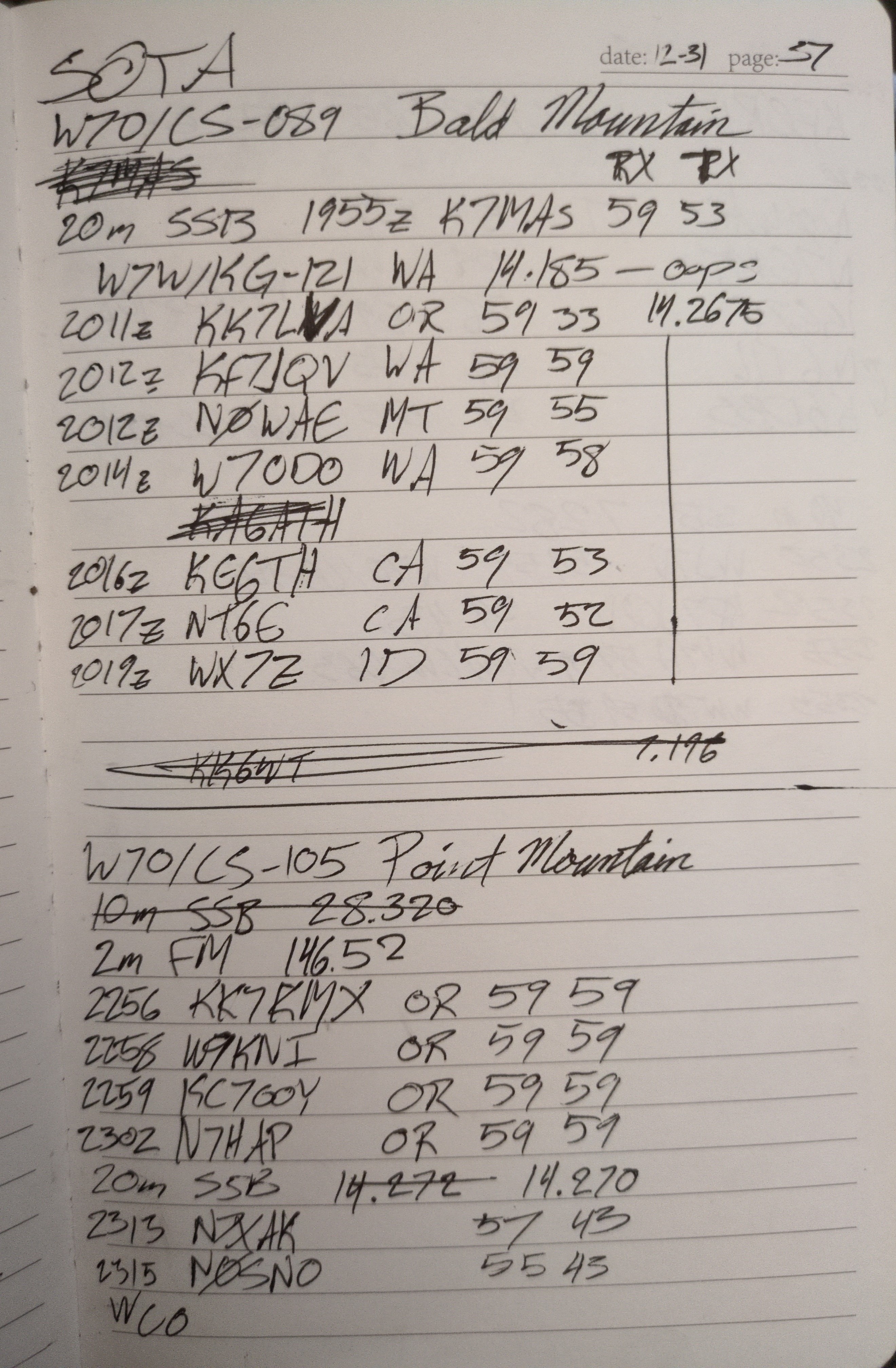
I had it pretty easy here. Amy called CQ, worked each contact, and then passed the mic over to me. All I had to do was to not panic, which is a lot easier said than done. After a few contacts I started to get the rhythm, and my nerves began to subside.
Phone signals (like I was using) contain lots of information in order to reconstruct an approximation of voice audio on the receiver's end. Since radio signals degrade in quality the further they travel, the voice information can get jumbled up quickly. On the other hand, a Morse Code (referred to by hams as CW for "continuous wave") signal has far less information: just a simple on or off. This means that CW is more resilient against degradation, and can travel farther before becoming unrecognizable. All of my contacts were in the western US: Southern California, Northern Washington, and Central Montana. When Amy worked several CW contacts, her range was much further, reaching Colorado, Texas, Tennessee, and Alabama. She told me that on good days, she's reached as far as Japan and New Zealand!
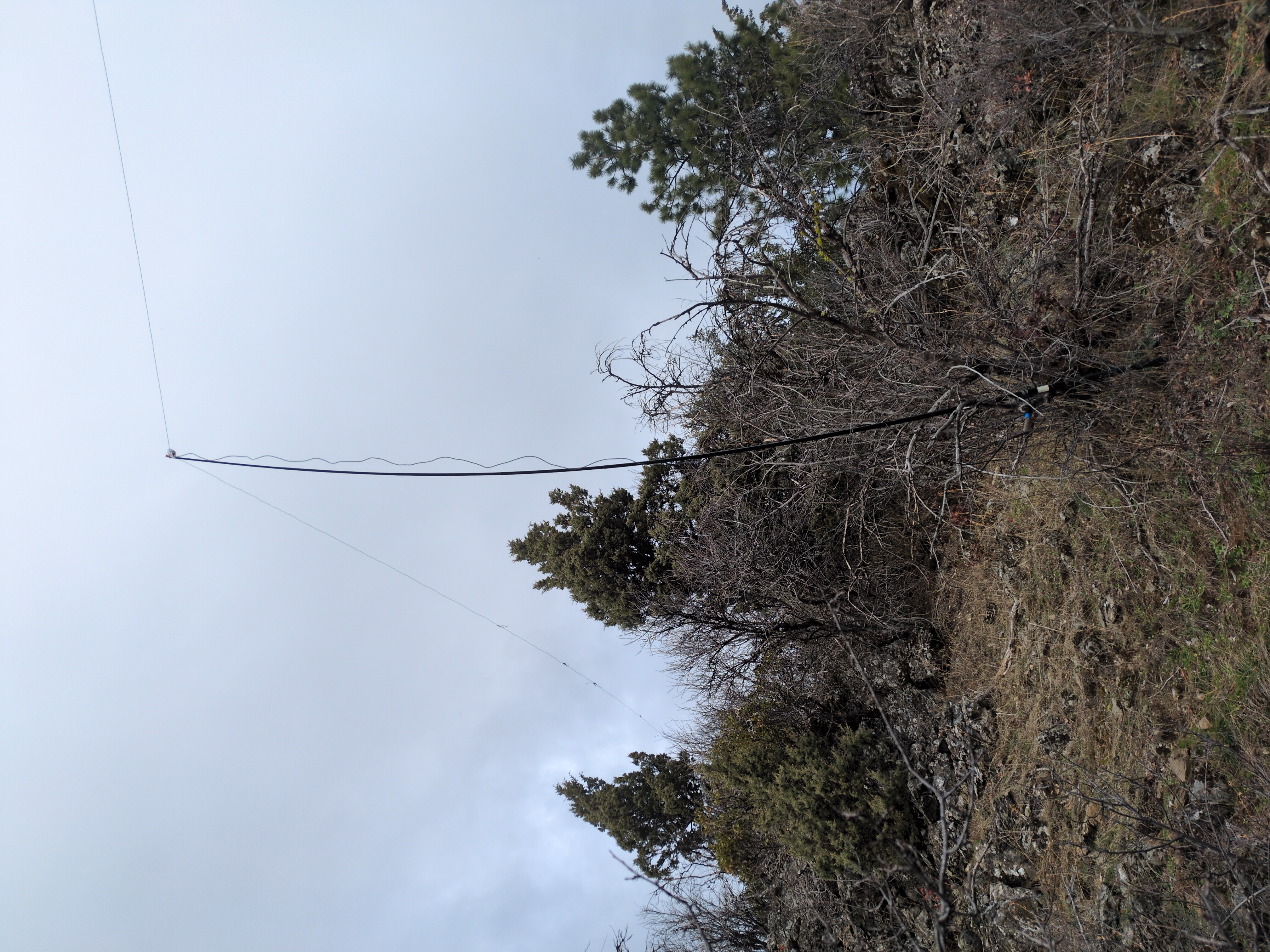
After a quick lunch, we headed down the road to Point Mountain W7O/CS-105. The hike here was a lot steeper. At the end, we had to cut off the trail to reach the summit, and needed to switchback across the hill to stay upright. At the summit, we used her linked dipole antenna this time. It is normally resonant on the 40 meter band, but can be easily adjusted to 20m, 17m, 15m, 12m, or 10m by just unplugging the corresponding connector along the wire, changing its length. This is a really simple but impressive way to utilize multiple bands on a portable antenna, and I'm thinking that I might have to make this modification to my dipole as a future project.
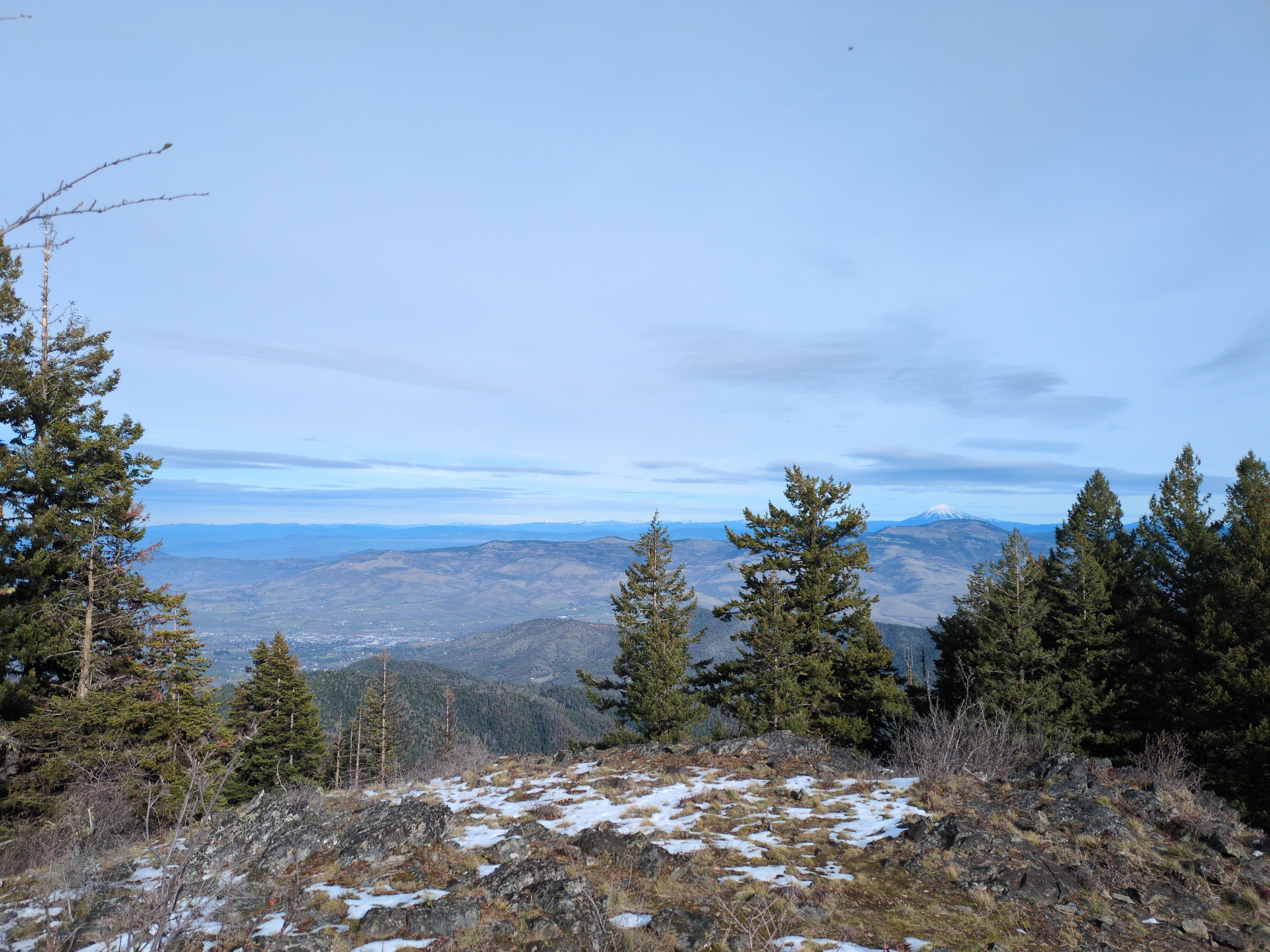
On Point Mountain, Amy increased the difficulty for me. She called CQ, but when several stations came back, she had me work all of them consecutively. This was stressful, but really fun! When I stumbled, Amy was still available to help me with what to say. As I got more comfortable, she let me take control while she stepped away and worked local contacts on a Quansheng UV-K5 handheld transceiver. Then it got really chaotic when we were both bouncing back and forth between the two radios! The contacts themselves became pretty straightforward, but I struggled most with writing down all the information I needed while keeping up the conversation.
Normally, when I find a problem, I can usually find someone online who has successfully been able to solve it. This is good in the case of simple issues, but the case of my radio was far from simple. I was quite nervous to reach out to local clubs for help, but I'm very glad I did. The amateur radio community is very supportive of new operators, and I got to experience that firsthand. That's something that internet searches just can't replace. SOTA was a blast, and I learned a ton having Amy as a mentor. I'm incredibly grateful to Amy, Scott, and Ken for their help and generous offers.